Whether you're seeking a small business loan or pitching investors, at some point someone asks for "a real business plan" — not a napkin sketch. That's when most founders discover the second sticker shock of starting a business: writing the plan itself costs money too.
What business plan writers actually charge
- Freelance writers: typically $500–$3,000 per plan, depending on length and how much research is involved.
- Consulting firms: $1,000–$25,000+ for investor-ready plans with full financial modeling, market research, and multiple revision rounds.
The gap between those numbers comes down to one thing: how much of the thinking you've already done yourself versus how much the writer has to extract from you — or guess at — themselves.
What actually goes into a fundable plan
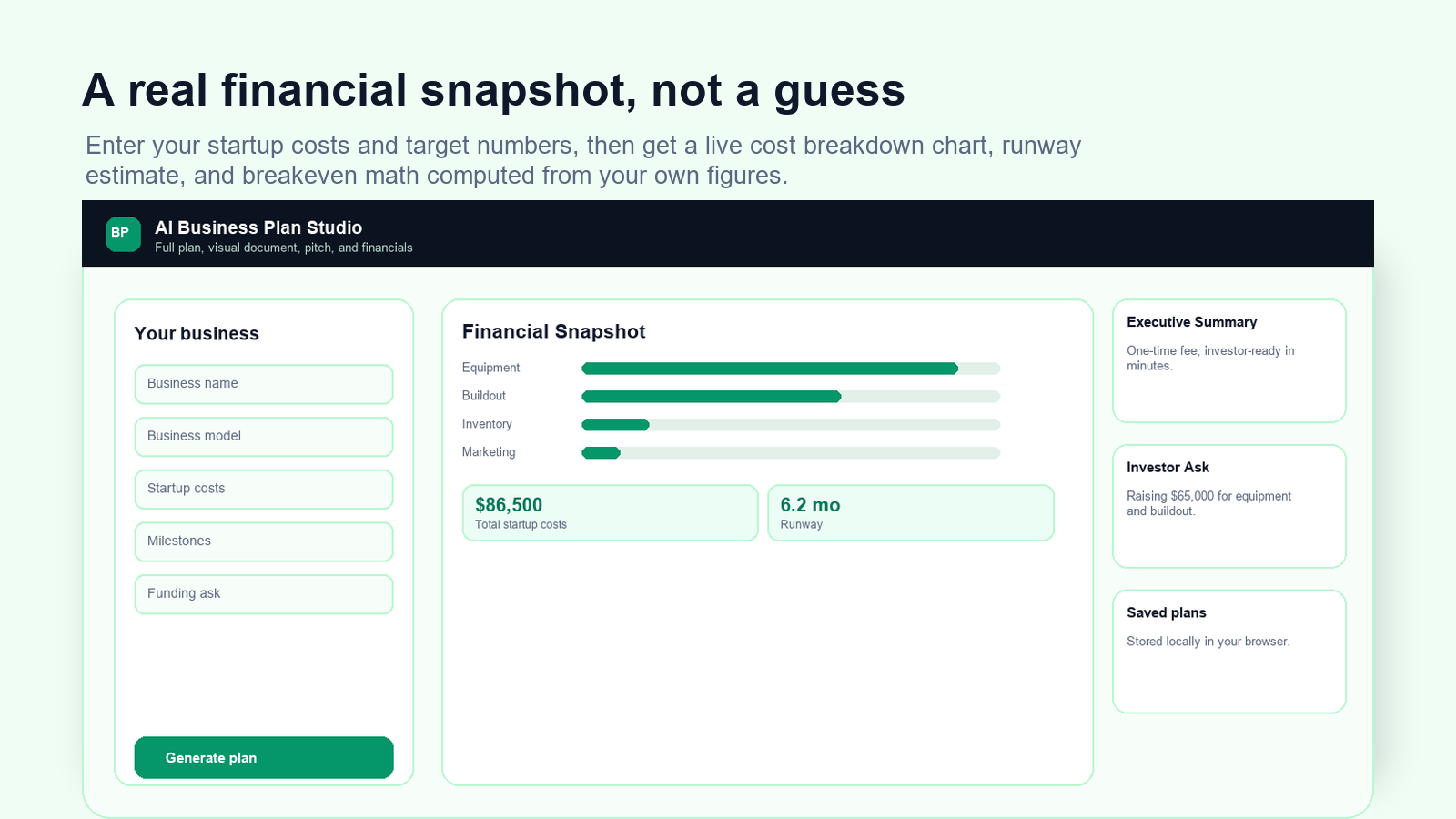
A plan a lender or investor will take seriously usually needs an executive summary, an elevator pitch, a real financial snapshot (startup costs, runway, breakeven), and a SWOT analysis — plus, ideally, both a plain-text version and a designed, presentation-ready layout.
The DIY alternative
If you already know your costs, your monthly burn, and your revenue goal, a consultant is mostly doing arithmetic and formatting with your numbers — not conjuring insight you don't have. That's exactly the kind of work a structured tool can do for you, once, instead of paying per draft.
What to budget either way
Investors and loan officers care about whether the numbers hold up, not whether you paid a consultant to type them. A one-time tool and an honest look at your own costs can get you the same sections a $1,000+ consultant would deliver — it just can't invent a market opportunity or a revenue number you haven't actually validated.
Frequently asked questions
How much does a business plan writer cost?
Freelance business plan writers typically charge $500-$3,000 per plan. Consulting firms charge $1,000-$25,000+ for investor-ready plans with full financial modeling.
Do I need a consultant to write a business plan?
Not necessarily. If you know your costs, burn rate, and revenue goals, you can structure a complete plan yourself — a consultant's fee mostly pays for organizing information you already have.
What sections does a real business plan need?
At minimum: an executive summary, a financial snapshot (startup costs, runway, breakeven), and a SWOT analysis. Investors and lenders also expect a clean, presentation-ready format, not just plain text.